If Your Dog Is Limping and Reluctant to Walk, the Cause May Be Patellar Luxation.
This case involves a 5-year-old, 2 kg Miniature Poodle that underwent bilateral surgery for patellar luxation (dislocated kneecaps).
The owner brought the dog to our hospital because:
→ The dog had recently become reluctant to walk.
→ The gait had become unstable.
→ The dog frequently limped or held one hind leg up while walking.
Examination & Diagnosis


During the examination, patellar luxation was diagnosed in both knees, with the condition progressing to Grade II in one leg and Grade III in the other.
On orthopedic examination, both kneecaps were unstable and could be easily displaced from their normal position. X-rays also clearly confirmed that both patellas had moved out of their normal alignment.
Surgery & Treatment
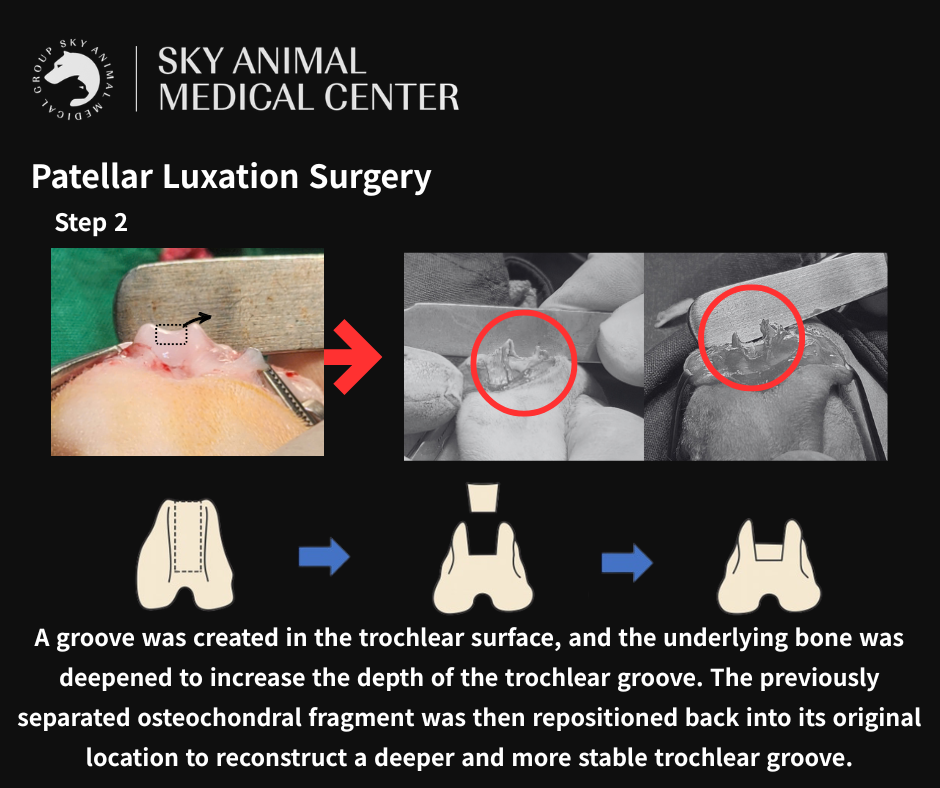
→ After general anesthesia, the surgical area was clipped and prepared under sterile conditions. The knee joint was then opened to evaluate the trochlear groove.
→ As expected, the trochlear groove was found to be much shallower than normal. In the Grade III knee, signs of osteoarthritis were also present.
→ Patellar luxation is very common in small-breed dogs. To keep the kneecap in its normal position, trochlear groove deepening surgery is often required.
→ In very small dogs, however, the force applied during this procedure can occasionally place stress on the hip joint and, in rare cases, cause hip luxation. For this reason, our experienced veterinary surgeons carefully positioned the limb and maintained the correct surgical angle throughout the procedure to perform the surgery as safely and accurately as possible.
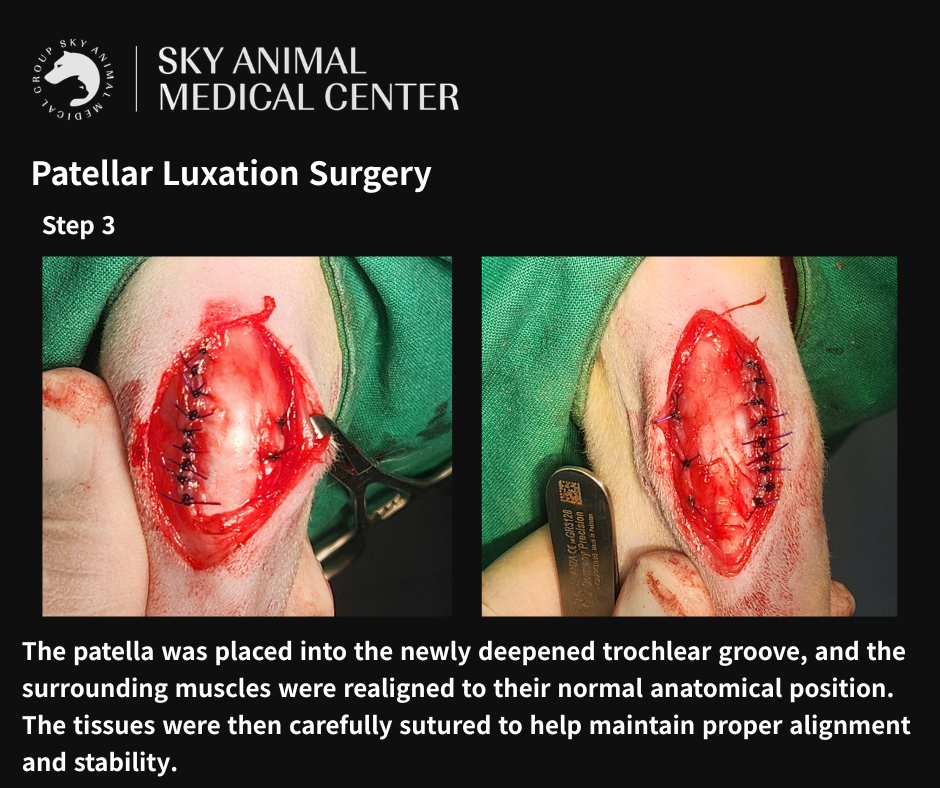
→ After deepening the trochlear groove, the patella was returned to its normal anatomical position. The knee joint was repeatedly flexed and extended to confirm that the kneecap remained stable and did not luxate again.
→ The surrounding muscles were then carefully sutured following the natural direction of the muscle fibers to promote proper healing and function. To further reduce tension on the surgical site during recovery, an additional tension-relieving technique was performed on the opposite muscle layer, helping improve stability and support rehabilitation.

Postoperative Care & Rehabilitation
The early recovery period is especially important after patellar luxation surgery.
→ For the first three days, the leg was supported with a bandage to keep the knee stable and allow the surgical site to heal.
→ From Day 4, the bandage was removed, and rehabilitation began step by step:
standing → weight-bearing → walking.
This gradual rehabilitation helps restore a normal walking pattern while improving muscle flexibility and supporting healthy joint function.
Even when the same surgical technique is used, attention to small details can make a significant difference in a patient's comfort and recovery speed.
At SKY ANIMAL HOSPITAL, we believe that these details matter. That is why we are committed to providing meticulous surgical care and thoughtful rehabilitation for every patient.
SKY ANIMAL HOSPITAL
Related articles